Research on gravitational shear analysis using Bayesian
neural networks to study dark energy
CIFRE doctorate between
Mews Labs
and the APC
laboratory — gravitational shear analysis with Bayesian neural
networks, for the study of dark energy with the Vera C. Rubin Observatory.
Scroll to deblend
PhD candidate · Machine learning & astrophysics
Hello and welcome!
I am Anna Preto, a PhD candidate in machine learning and astrophysics.
I am carrying out a CIFRE doctorate between
Mews Labs
and the APC
laboratory, on gravitational shear analysis using Bayesian neural
networks to study dark energy, within the Vera C. Rubin Observatory (LSST).
Galaxy formation & evolution
Interactions in galaxy clusters
Dark matter
Theoretical cosmology
Machine learning for astrophysics
01Background
Experience
2025 — present
PhD candidate in cosmology and machine learning
CIFRE doctorate between
Mews Labs
(Cachan) and the APC laboratory
(Paris).
Gravitational shear analysis with Bayesian neural networks for the study of
dark energy — Vera C. Rubin Observatory / LSST.
Supervisors : Dr. Éric Aubourg, Dr. Cécile Roucelle ;
industrial supervisor : Dr. Vincent Laurent.
Design and deployment of ML solutions : CNNs and ViTs for imaging,
time-series forecasting models, LLM fine-tuning, NLP, and production
deployment with CI/CD pipelines.
2024 · March — July
Master's thesis — CEA Saclay
Study of how the dark matter content of massive galaxies depends on their
properties, supervised by Dr. Camila Correa.
2023 · May — July
First-year Master's thesis — École des Chartes
Modelling the propagation of manuscripts and manuscript traditions,
supervised by Dr. Jean-Baptiste Camps and Julien Randon-Fuerling.
2022 · May — July
Bachelor's thesis — CEA Saclay
Star formation and protoplanetary discs,
supervised by Dr. Mathias González.
2021 — 2022
Head of the design department — Physis7
Physics student association, Paris.
Education
2023 — 2024
MSc — Astronomy, Astrophysics and Space Engineering
Université Paris VI — Paris and Meudon Observatories. With honours.
A guest lecture for first-year Master's students in Fundamental Physics, as part
of the Modelling and Machine Learning course. The conference-style session
introduced LLMs and generative AI through the methods and production questions I
work on at Mews Labs.
Benchmarking Foundation Models for Unsupervised Discovery in Large Multimodal Astrophysical Datasets
Euclid × DESI
AstroPT · AION · AstroCLIP
Accepted paper
M. Ronceray, M. Huertas-Company, A. Chanson, M. Siudek, A. Preto, M. J. Smith, J. Zoubian and C. Bonini
A multimodal benchmark for finding rare and scientifically interesting objects
in matched Euclid images and DESI spectra.
Approach
The same galaxy sample is encoded with three astronomical foundation models.
Lightweight density estimators rank objects that are rare within an individual
representation or unusually misaligned across image and spectrum.
Extract image, spectral and joint embeddings for every object.
Estimate rarity in each representation with normalizing flows.
Compare model rankings and inspect the highest-scoring candidates.
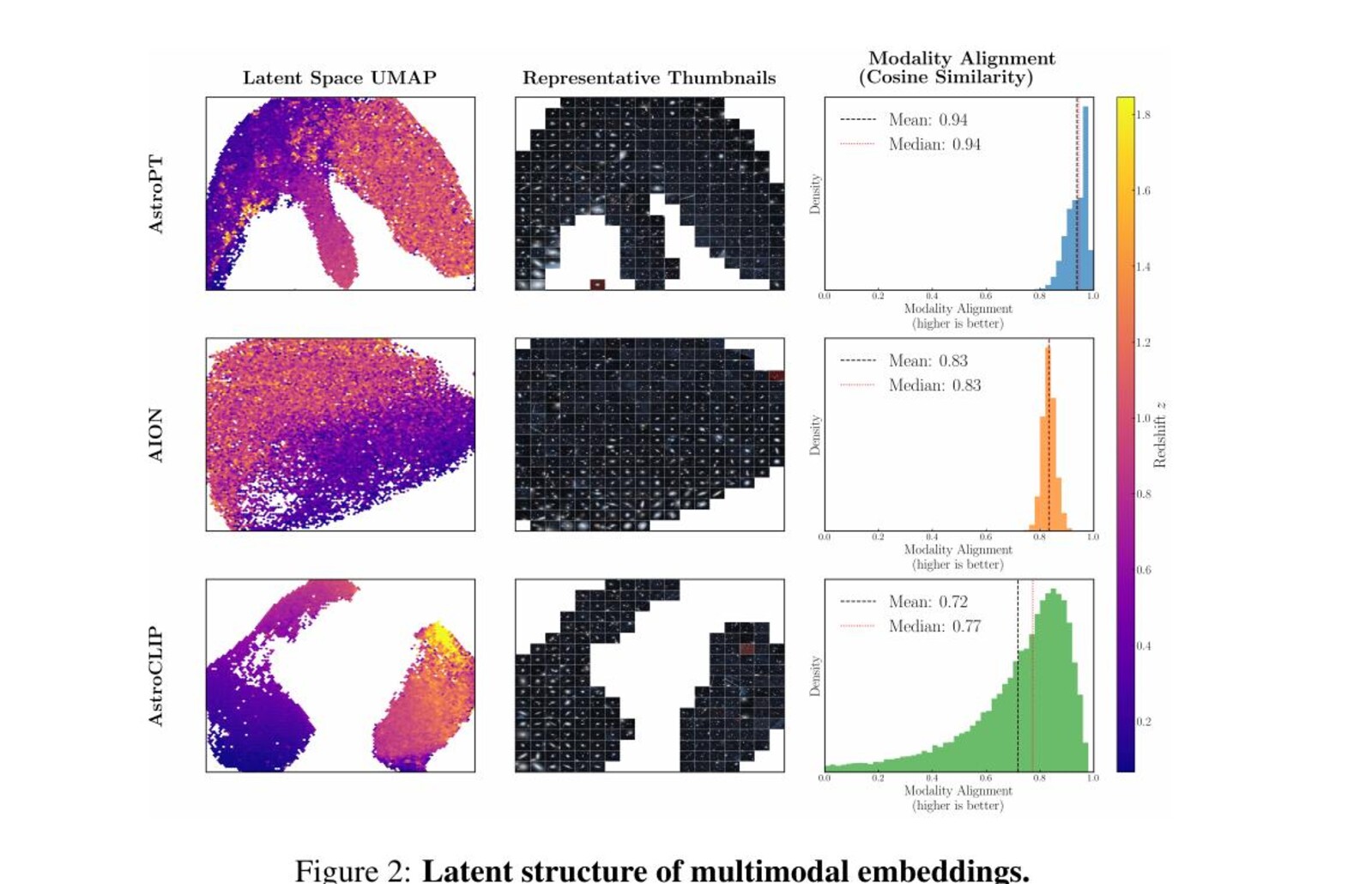
Representation geometry changes with the model. AstroPT and AION form comparatively continuous manifolds, while AstroCLIP is more fragmented and produces a broader image-spectrum alignment distribution.
Findings
The most extreme candidates partly agree across models, but the broader rankings
diverge. Consensus highlights robust rare systems, while disagreement exposes
sensitivities introduced by each architecture and training objective.
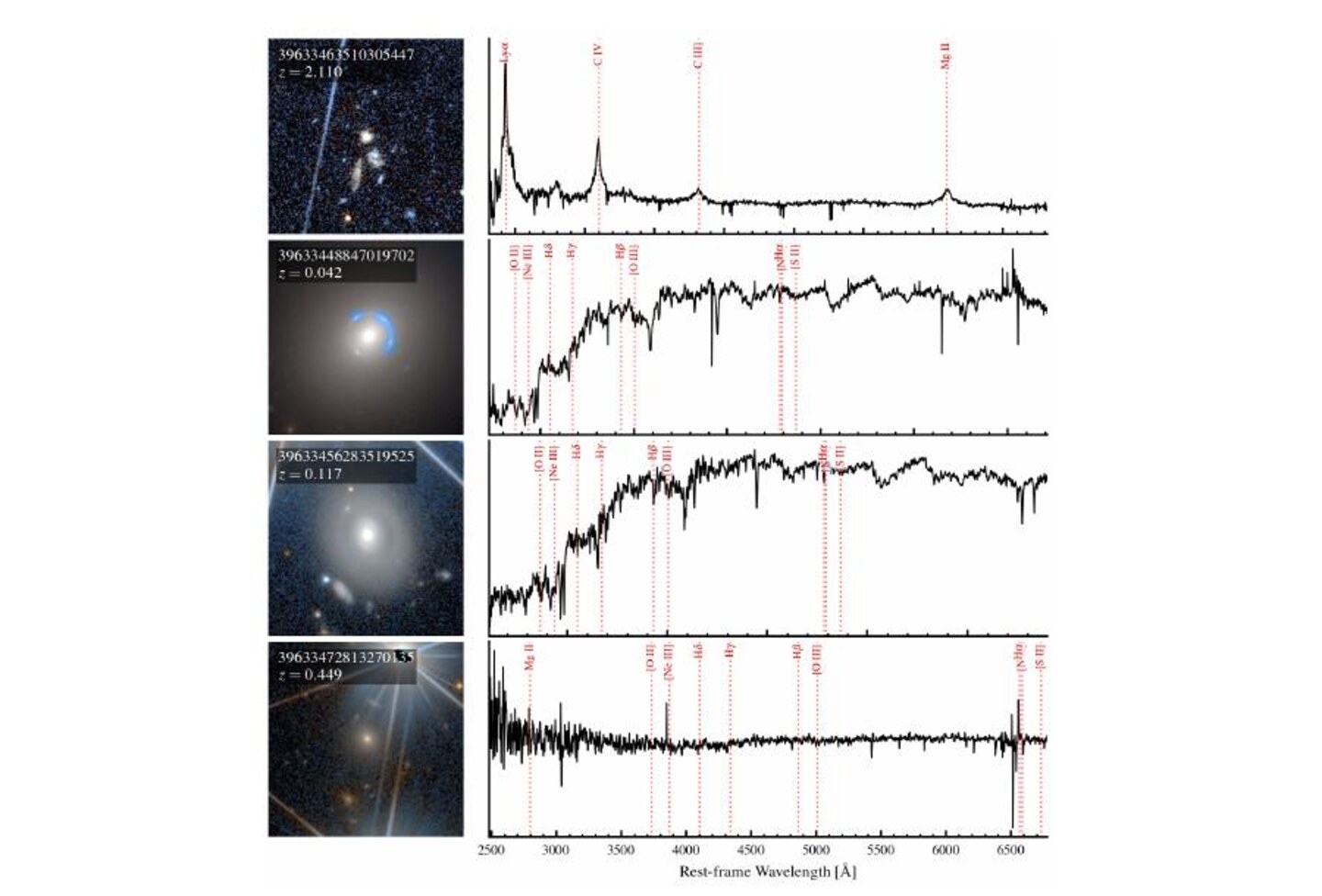
Visual inspection surfaces both astrophysical candidates and data-quality issues:
AGN-like spectra, strong-lens morphologies, unusual quiescent systems, diffraction
spikes and residual imaging artefacts.
Images and spectra remain paired during interpretation. Representative high-ranking candidates show how physical anomalies and instrumental artefacts can both drive rarity scores.
Takeaway
Foundation models do not define a single notion of rarity. Comparing their views
is part of the discovery method itself, not only a benchmarking exercise.
The existence of dark matter is firmly established by observation, yet its
particle nature remains undetermined. This project asks what massive galaxies
can tell us about it.
The small-scale problem
The standard cosmological model — ΛCDM, in which dark matter is cold and
collisionless — reproduces the large-scale structure of the Universe with
remarkable accuracy. On galactic scales, however, tensions appear. They are
best known for dwarf galaxies, but they are not confined to them.
Massive galaxies show the same kind of disagreement : CDM predicts a
larger dark matter fraction in the inner regions of galaxies than is actually
measured. The discrepancy sits precisely where baryonic physics and the nature
of the dark matter particle are hardest to disentangle.
Self-interacting dark matter
Self-Interacting Dark Matter (SIDM) is one of the more promising ways out.
If dark matter particles can scatter off one another, collisions transfer
energy outwards through the halo, reshape its structure and lower the central
densities — bringing predictions closer to what is observed in the inner
regions of galaxies.
The work studies how the dark matter content of massive galaxies depends on
their properties, and what that dependence implies for the allowed
self-interaction cross-section.
Key results
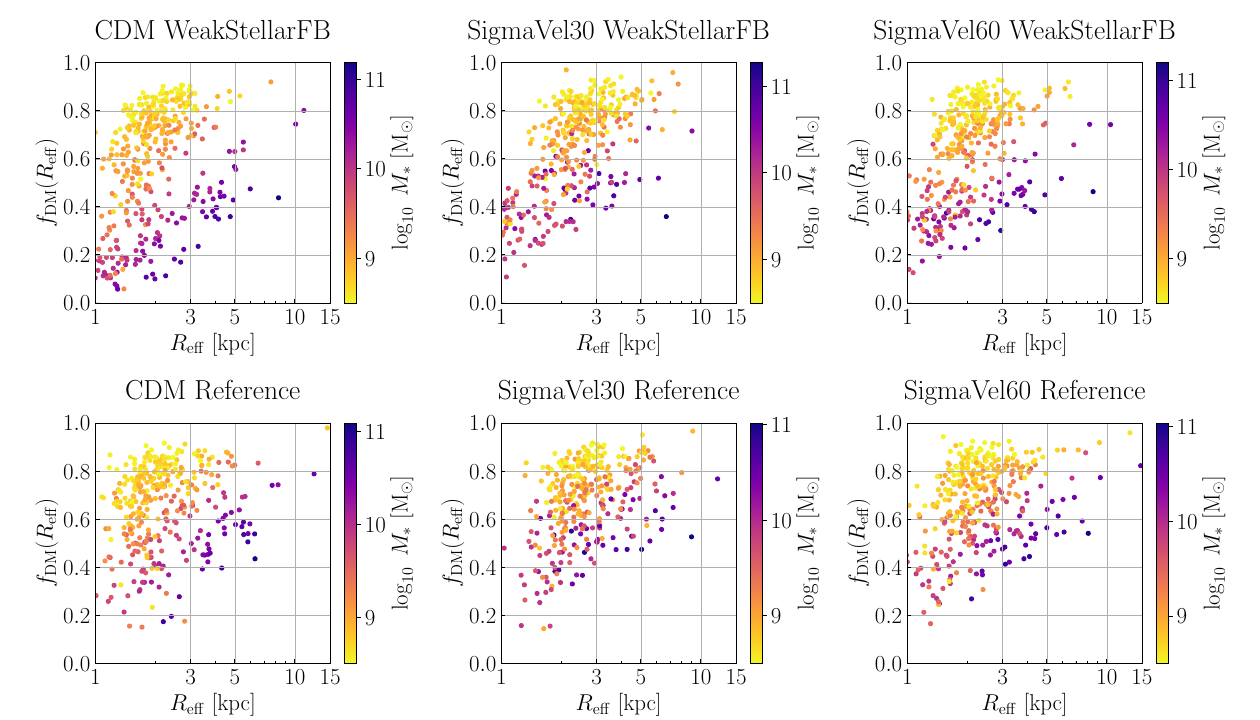
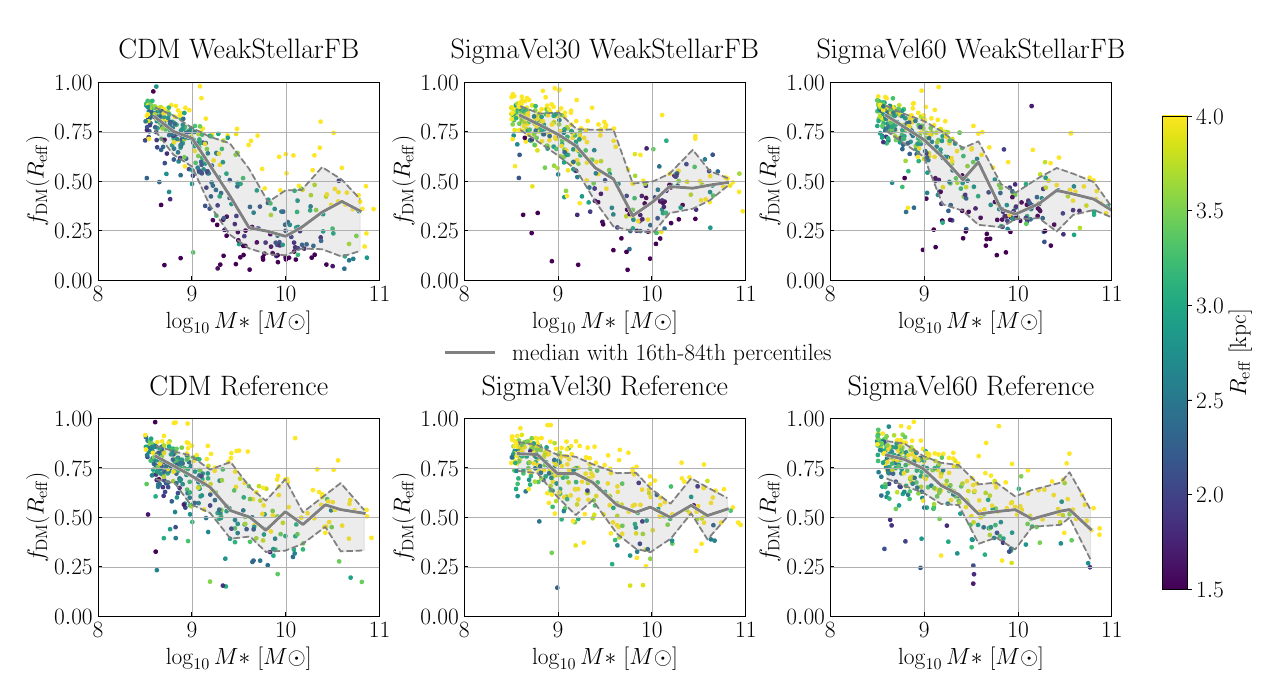
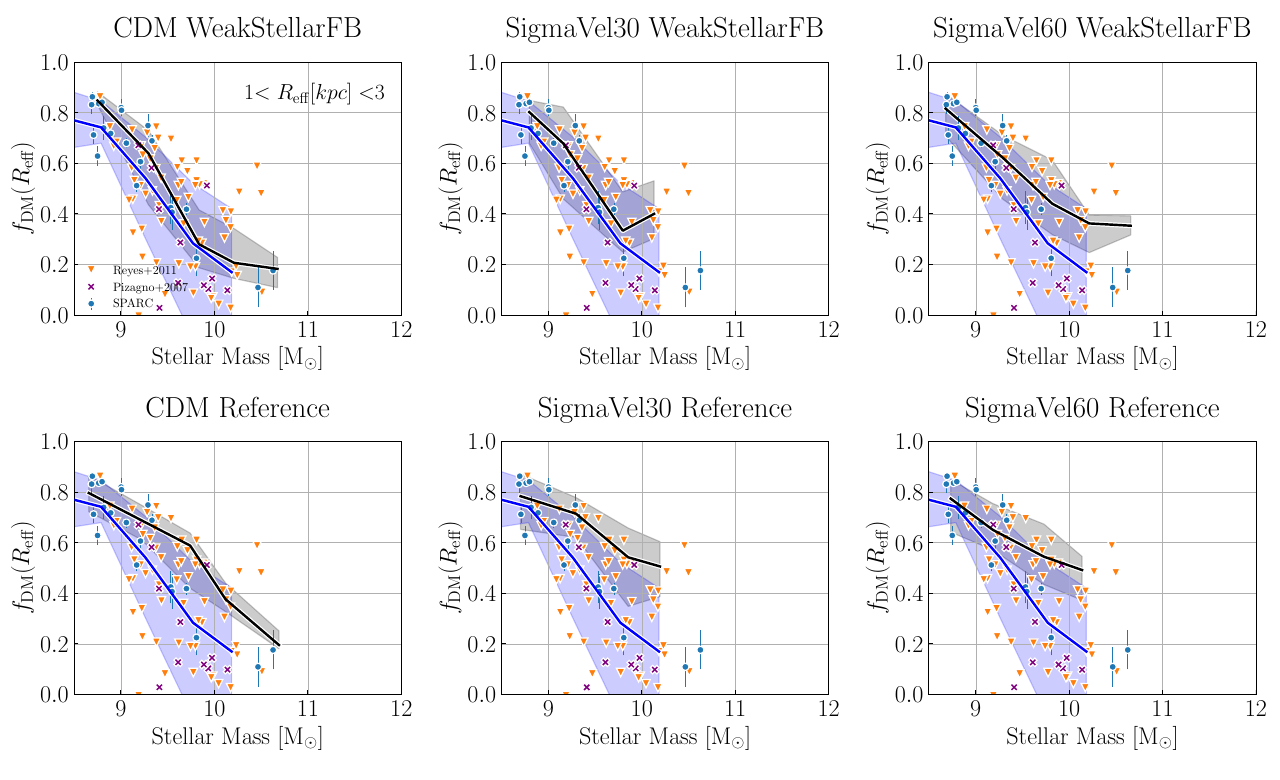
Compactness is a key variable. At fixed stellar mass, more compact galaxies contain a lower fraction of dark matter inside their effective radius. Moving from CDM to SIDM also makes the simulated systems more extended.Baryonic feedback and dark matter physics remain entangled. SIDM raises the median inner dark matter fraction in the compact WeakStellarFB galaxies, but particle interactions alone do not erase the effect of gas overcooling.The observational comparison breaks part of the degeneracy. For late-type galaxies of comparable size, two WeakStellarFB models lie within the observed scatter, while the Reference models do not reproduce the same relation.
Status
Paper in preparation. The full internship report from 2024 is available below.
Can the genre of an artist — and the influences running through their albums —
be recovered from audio features alone ?
Data
Track-level features were collected through the Spotify API across four
clearly separated genres : rock, hip hop, electronic and classical music.
Each track becomes a point in a feature space, and each artist a cloud of
points in it.
Methods
Several approaches were compared, deliberately spanning very different
families of models :
Principal component analysis, to see how much of the genre separation
survives in the first few components.
k-nearest neighbours, as a purely geometric baseline.
Bayesian inference, to get calibrated probabilities rather than hard labels.
Neural networks.
Random forests — which turned out to perform particularly well here.
What came out of it
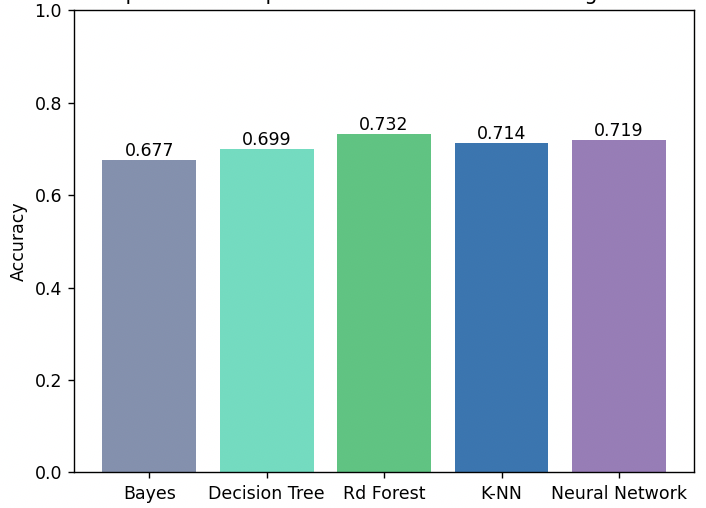
Satisfying classification is achievable even with relatively simple
algorithms : the genres separate well enough in feature space that the
heavier models buy comparatively little. The interesting part is less the
accuracy than what the confusions reveal about the influences shared between
albums.
Galaxy interactions are among the most dynamic events in the Universe. This
project simulates one from scratch : build a galaxy at equilibrium, then
hit it.
Method
A galaxy holds on the order of 10¹¹ stars, far too many to integrate
individually. In a particle-mesh scheme each simulation particle instead
represents a cloud of stars, which samples phase space well enough to solve the
Vlasov–Poisson equation on a grid. The gravitational potential is computed on
that grid rather than pairwise, which is what makes millions of particles
tractable.
The simulation itself is written in Fortran for speed ; the visualisation
and analysis are done in Python.
What was explored
Starting from a stellar distribution in equilibrium, an incoming galaxy is sent
through it. The mass, velocity and compactness of the impactor are varied to
see how each disturbs the structure of the target — and how the disc responds
to repeated encounters.
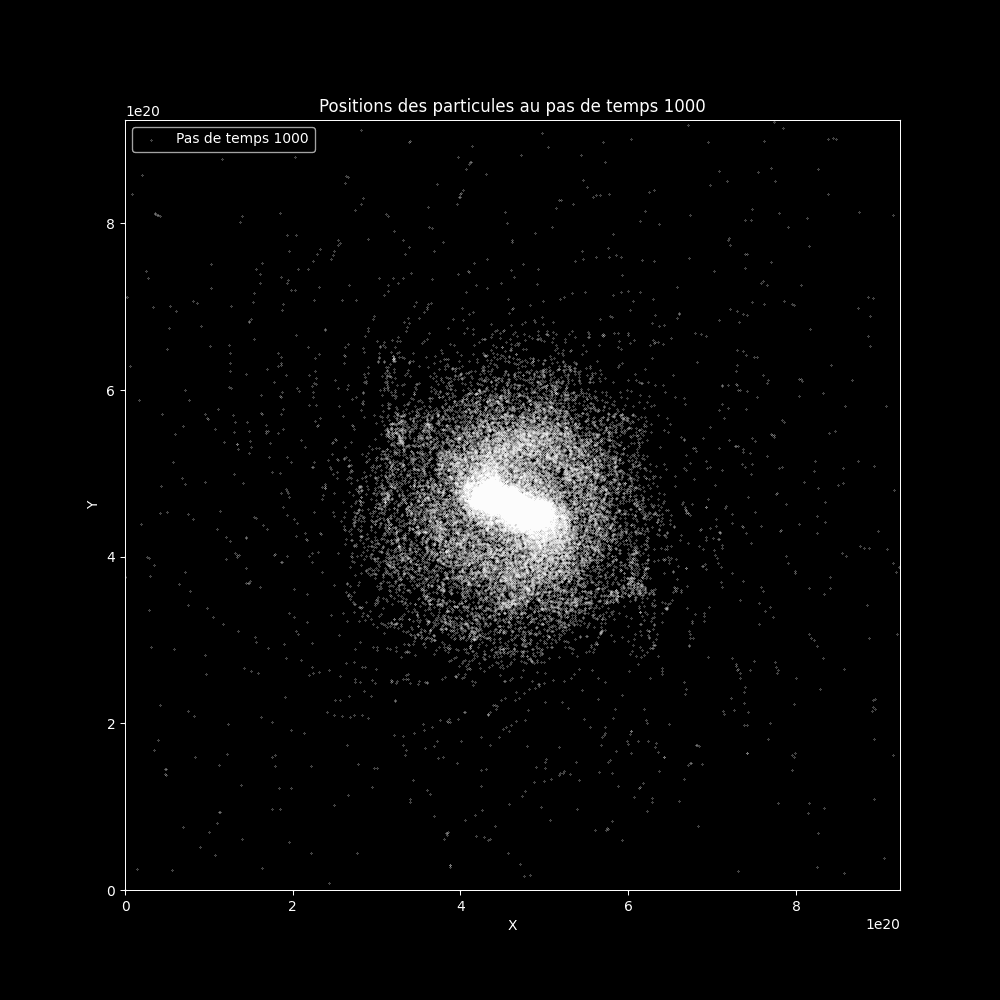
A frame from the simulation, seen face-on.
Side project
Observations at Haute-Provence Observatory
One observing week
T120 telescope
Coma cluster
A week at the Observatoire de Haute-Provence, retracing the measurement that
first revealed the missing-mass problem.
The target
In the 1930s Fritz Zwicky compared the velocity dispersion of galaxies in the
Coma cluster with the mass implied by their light, and found the cluster far
heavier than it looked. Coma is therefore the natural cluster to point a
telescope at when you want to meet dark matter observationally rather than
through a textbook.
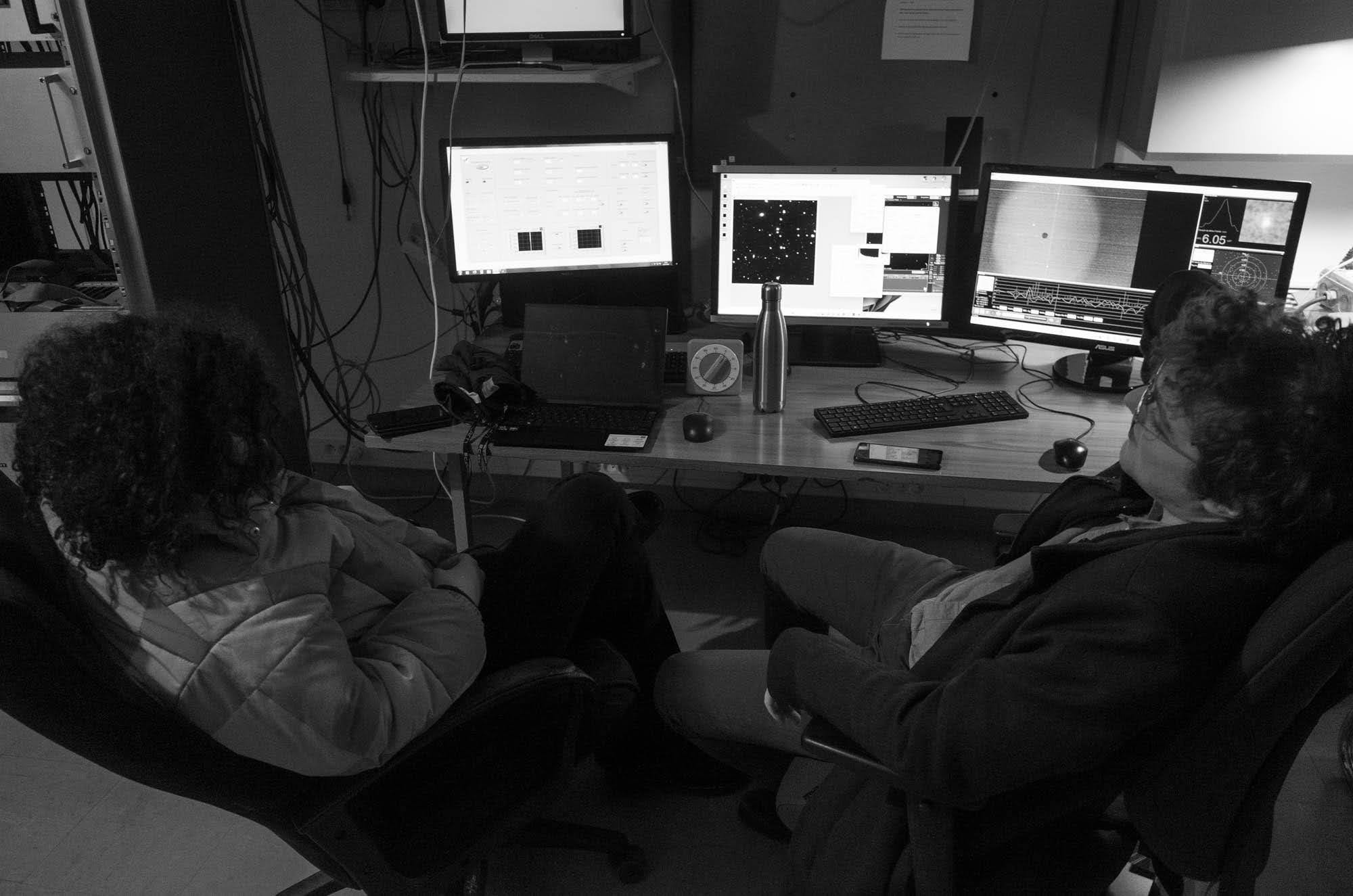
Observing and reduction
Images of the cluster were acquired in the visible with the observatory's T120
telescope, then reduced and analysed offline to estimate the cluster's luminous
mass and compare it with its virial mass.
What I took away
Beyond the result, the week was hands-on training on a professional
instrument : pointing and operating the telescope, planning an observing
night around the weather and the target's altitude, and carrying the data all
the way through reduction to a number.
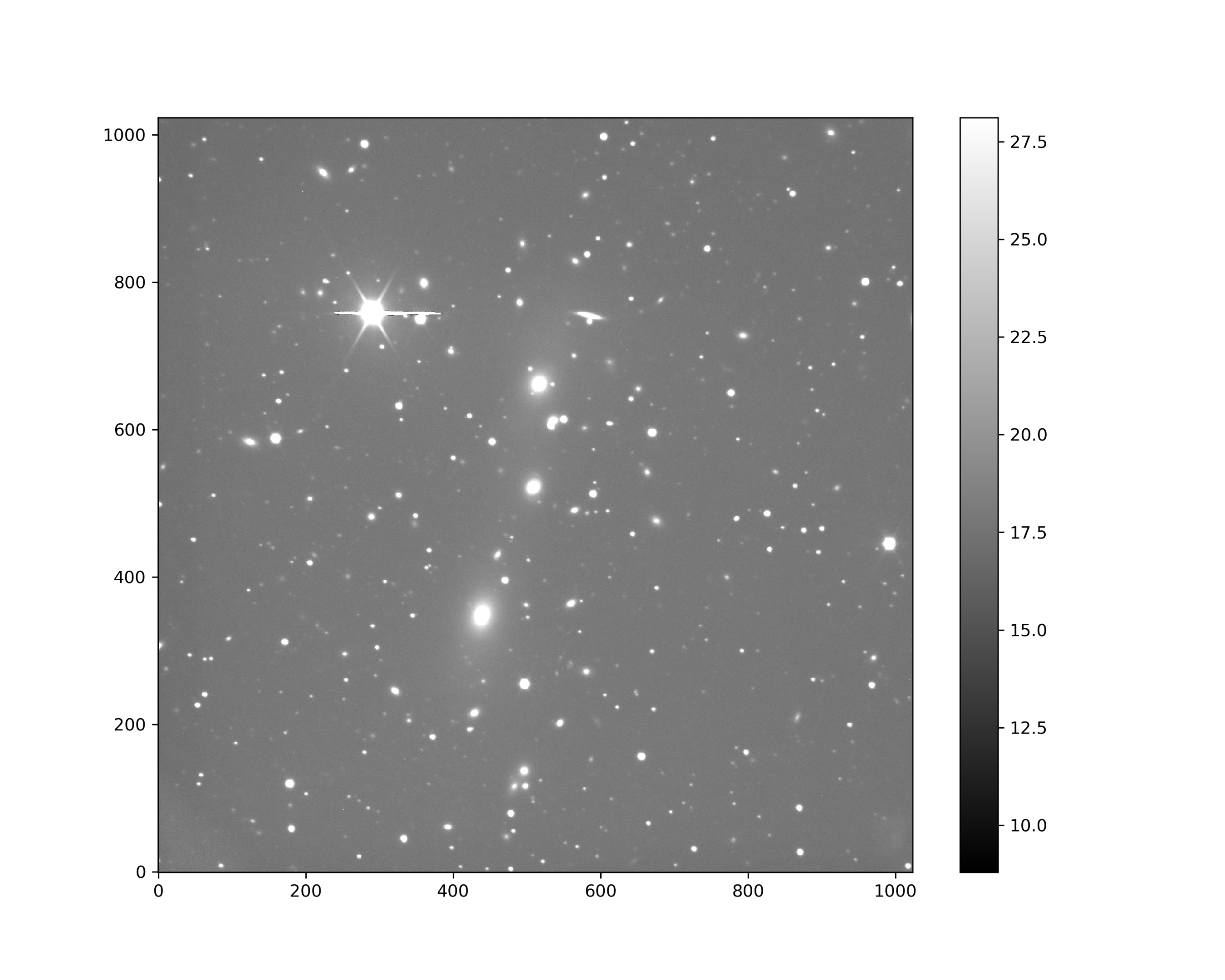
The Coma cluster, imaged in the visible with the T120.The observatory, somewhere past three in the morning.
Side project
Birthdays app
Dart
Android
Design & development
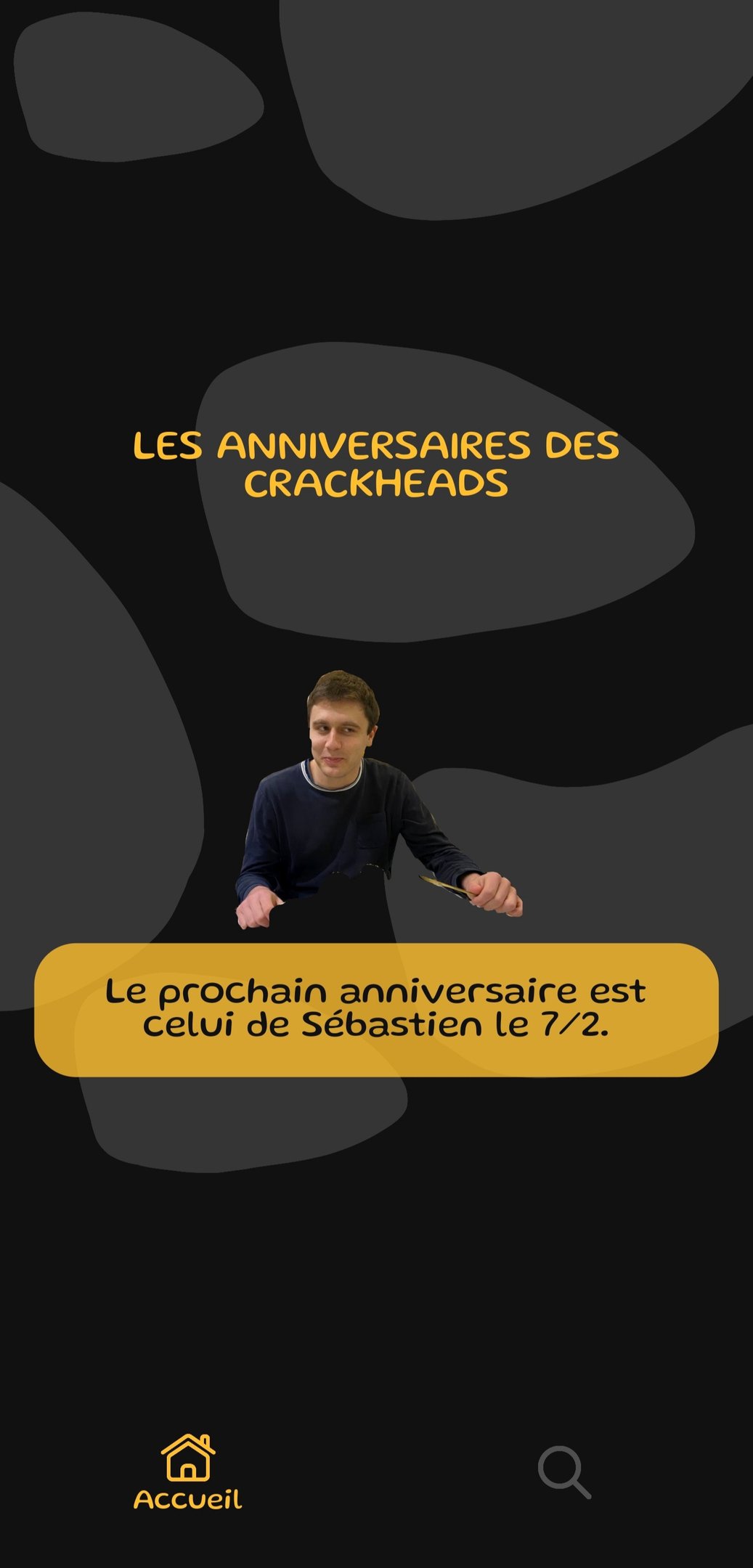
An Android app built to solve two problems at once : never forgetting a
friend's birthday, and learning mobile development.
Features
Notifications ahead of upcoming birthdays.
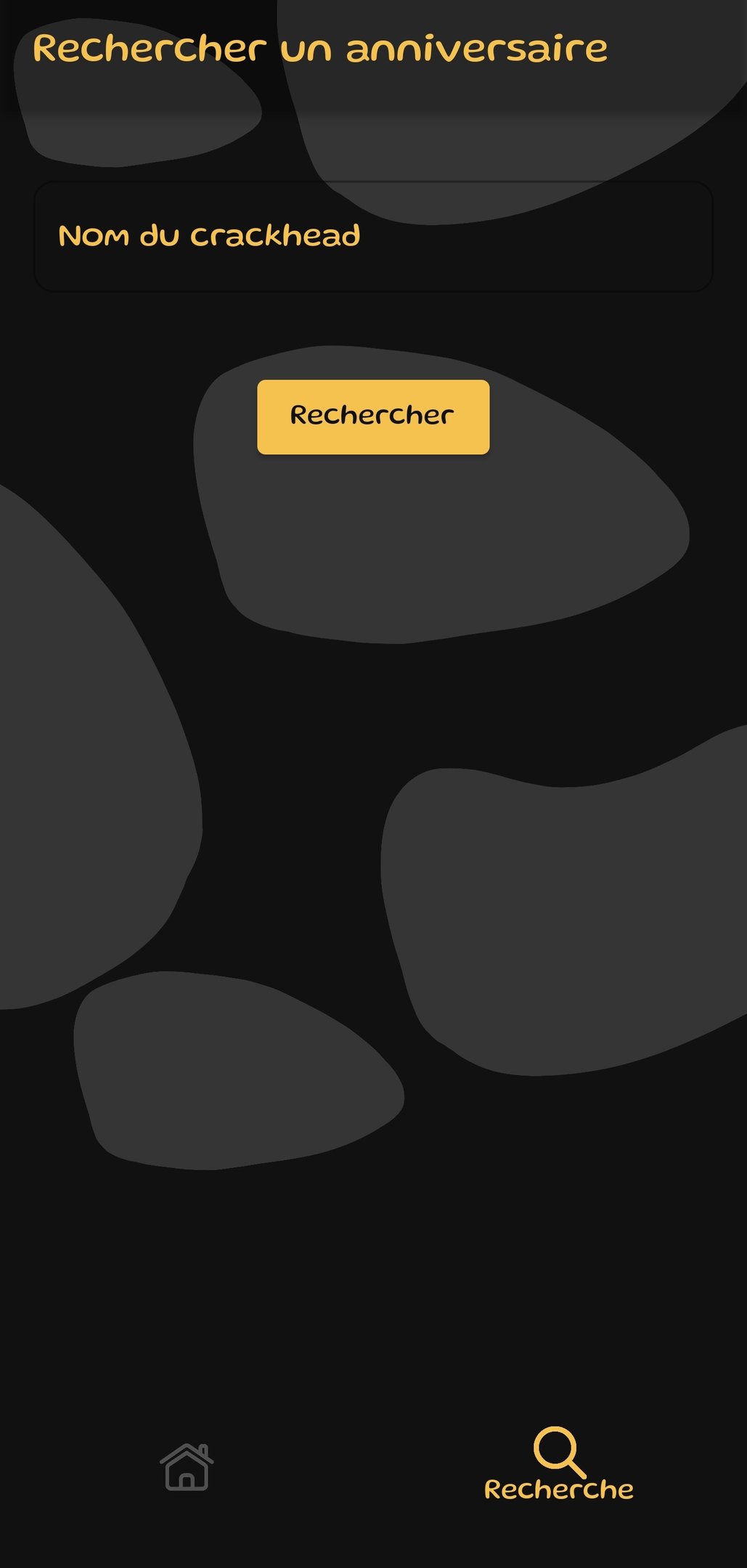
Search by first name to look up a friend's date.
Scope
Interface design and development were done end to end — a first experience of
shipping a mobile application, from the data model through to the notification
scheduling and the screens themselves.
Side project
ArcanAI
Python
Streamlit
LLM
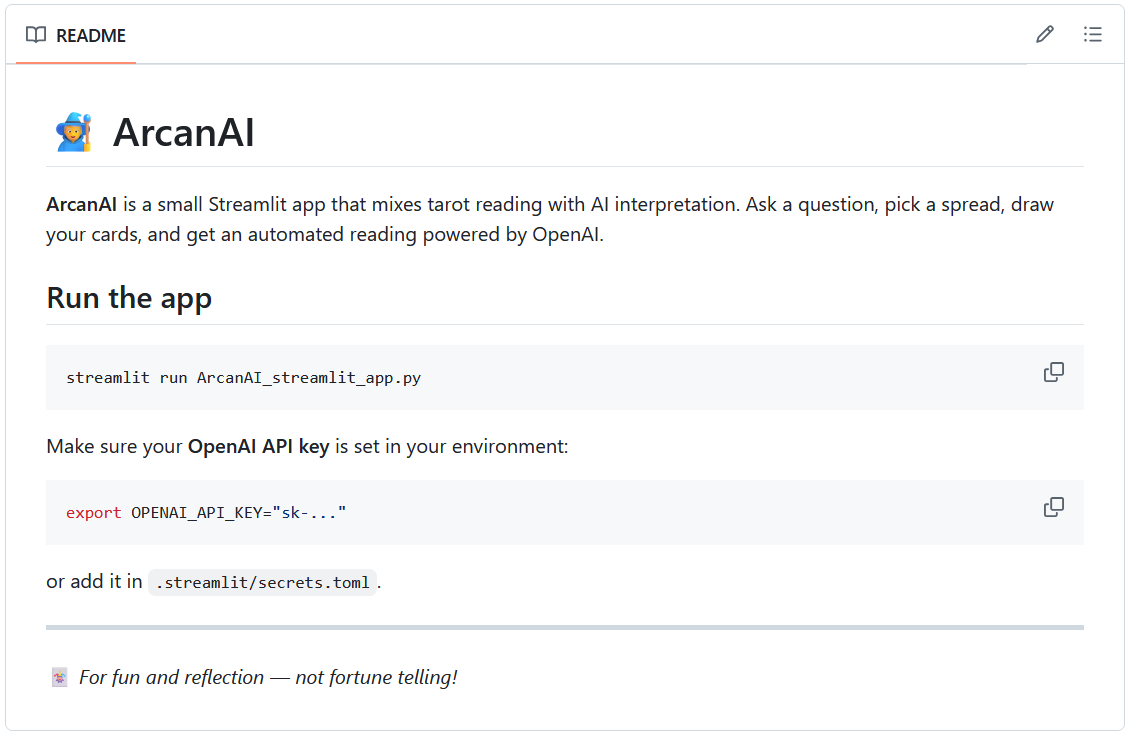
A tarot reading assistant : a very old practice handed to a very new tool.
How it works
You ask a question.
You pick a spread.
You draw the cards virtually.
A language model interprets the draw and writes the reading, taking both
the cards and the question into account.
Build
The whole thing runs as a Streamlit app in Python, which keeps the interface
close to the logic and makes the draw, the prompt and the rendered reading easy
to iterate on.
The interface : the draw on one side, the generated reading on the other.
Science communication
Ma thèse en 180 secondes
ASPC final
Université Paris Cité
Three-minute pitch
Three minutes to make a doctoral research question clear, precise and memorable
without assuming a specialist audience.
The MT180 format required compressing the scientific context, the central problem
and the motivation of the PhD into a single spoken narrative. The work was as much
about scientific accuracy as pacing, imagery and public communication.
Meeting high-school students to make scientific and technical careers more
concrete, accessible and open to them.
As an Elles bougent role model, I spoke about my path through physics and machine
learning, what research and industry work look like in practice, and the range of
studies leading to scientific and technical careers.
Shooting since 2016, on a Canon EOS 2000D, with a clear preference for
portraits.
Portraiture is where the camera stops being a recording device : the frame
is decided with the person in it, not around them. Alongside the portraits,
the portfolio carries what travelling turns up — architecture, landscapes,
and the occasional encounter — in black and white as readily as in colour.
Where it has gone
Photographer for Bateaux Parisiens.
Exhibited at the Bois-Colombes art salon, 2021 and 2022.
Portfolio
Other interests
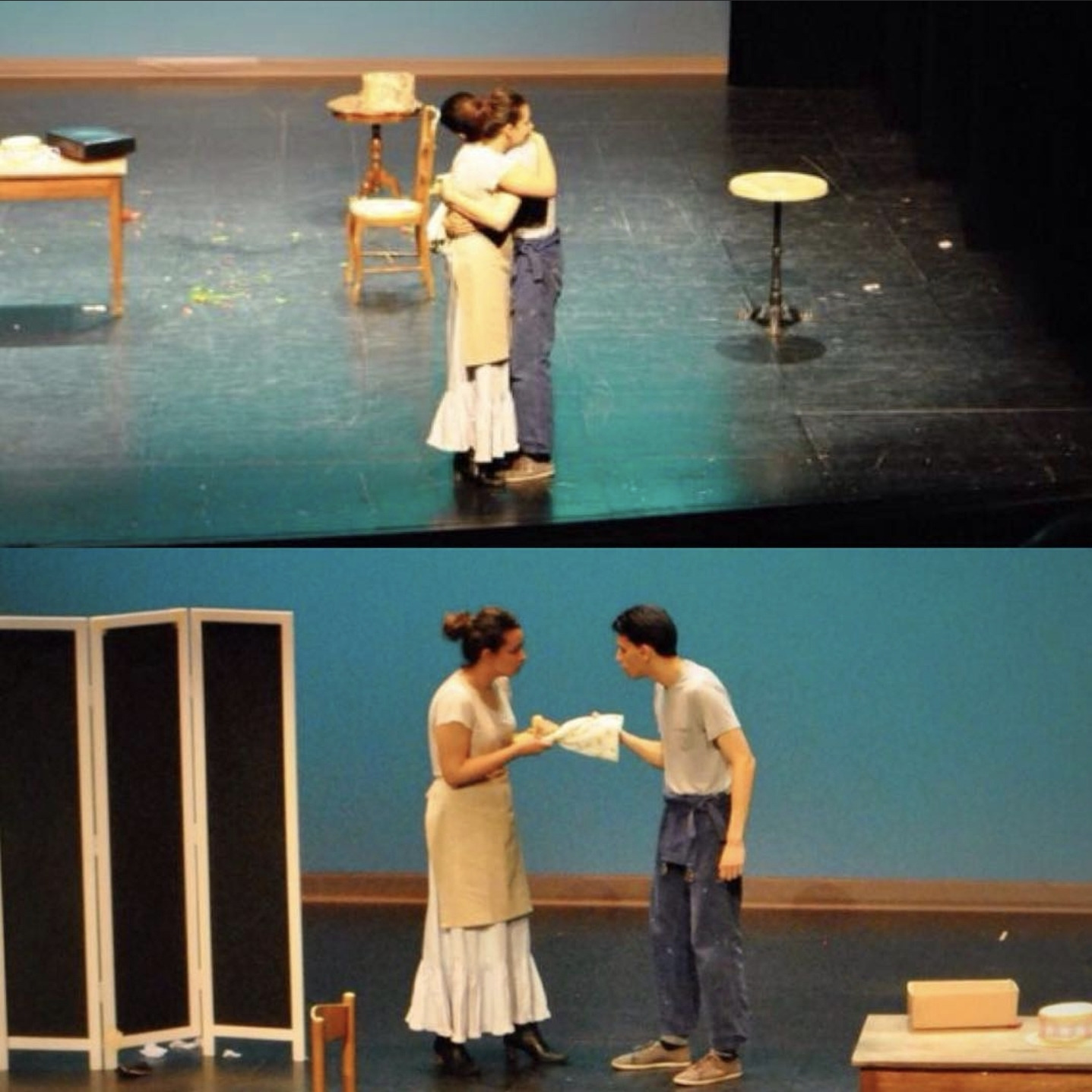
Theatre
Around ten years
Stage
About ten years of practice, across classical repertoire and contemporary
writing.
Among others : Cinderella, A Midsummer Night's Dream and
The Tempest, alongside contemporary plays.
Two productions in particular
Les gens biens — an adaptation of Hanokh Levin's
Que d'espoir !, directed by Alexandre Lenis.
L'Intervention by Victor Hugo, in the role of Marcinelle Barvin,
at the Théâtre du Figuier Blanc in Argenteuil.
Other interests
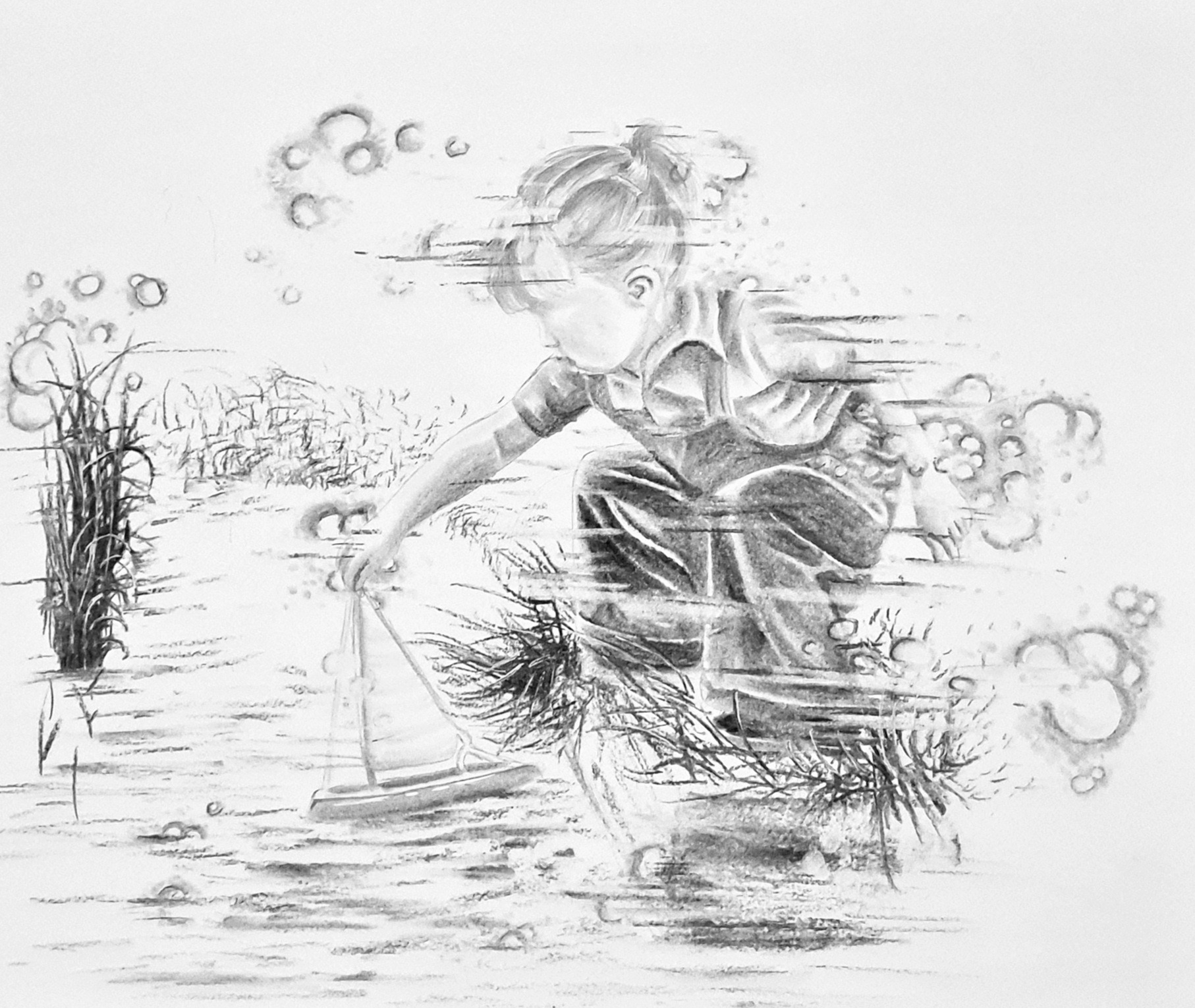
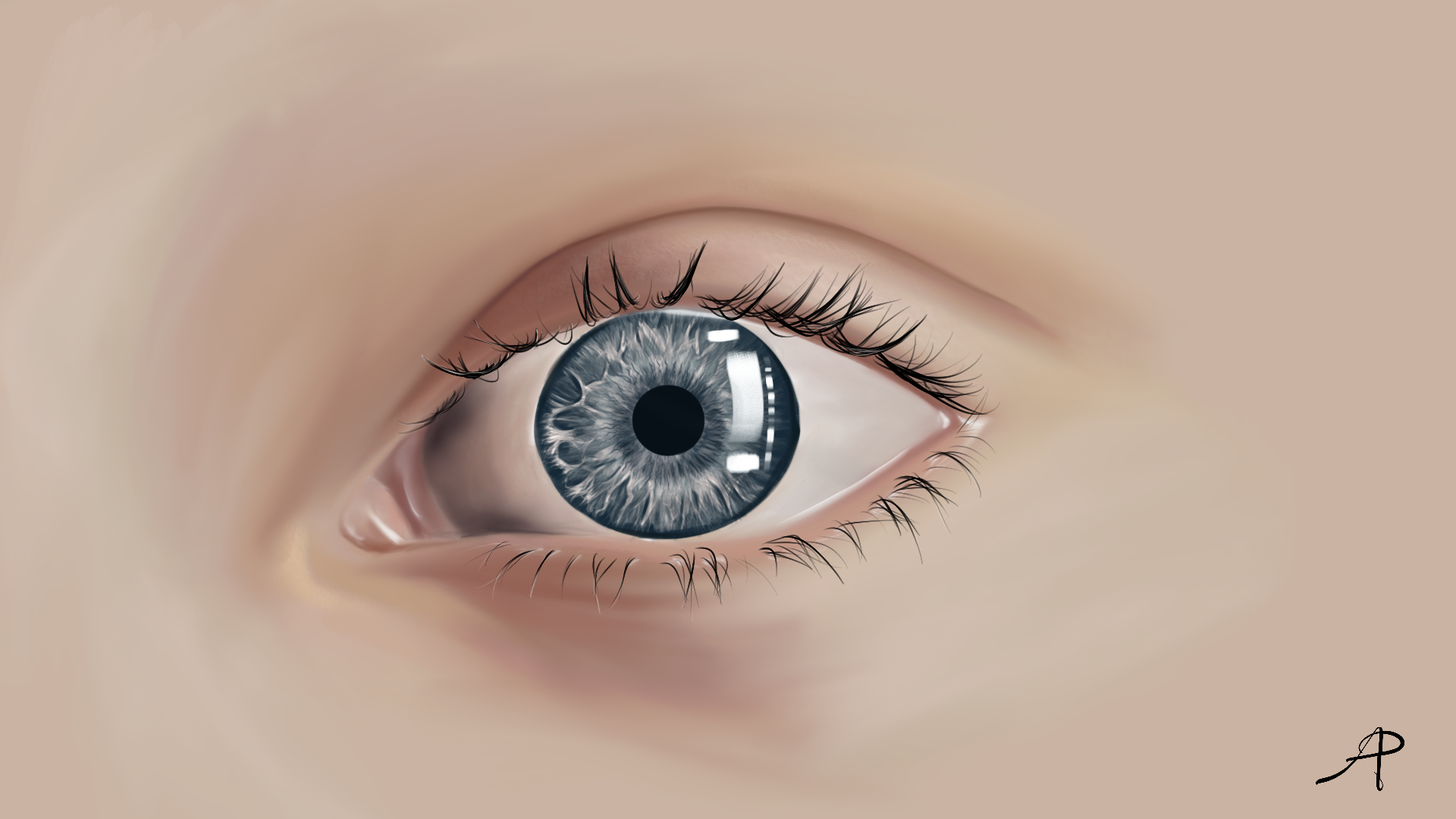
Visual arts
Graphite
Charcoal
Visual identity
“Drawing is the other passion of my life.”
Oil paint, digital art, watercolour, charcoal, pencil and pastel have all had
their turn — but graphite and charcoal are where the work keeps returning.
Both reward the same thing : value before line, and the patience to build
a face out of darkness rather than outline it.
Beyond drawing
Charcoal pieces have been shown at art salons, and the same eye goes into
commissioned work — logos and visual identities for companies.
Other interests
Poetry
Reading
Writing
Somewhere between Baudelaire and Jean-Yves Masson.
I am currently writing a collection titled Expression Barbouillée —
introspective, lyrical poems circling nostalgia, the loss of freedom, and the
way identity gives way under the weight of the real. The register is
melancholic and the imagery closer to the surreal than the descriptive.
A few of them are below, in the French they were written in.
Éclair
Un papier peint au motif enfantin
Revient des souvenirs anodins
Illuminer la pièce du passé
Le jus d'orange qui piquait les lèvres acidulées
Lors des matins lointains
Vient titiller nos papilles oubliées
Et l'époque assassine
Marque d'une nostalgie fine
Nos expressions barbouillées
Jus
Il y a des mots qui ne s'écrivent pas
Il y a des mots dans lesquels il faut mordre
Et dont coule un jus délicieusement parfumé
De baisers et de vie
J'étais un de ceux autrefois
Qui ne croit pas en l'hiver
Pourtant lorsque mes lèvres ont gelé
Et que les mots ont cessé de résonner
J'ai été forcée d'admettre ma défaite
C'était les mots qui me dévoraient
Le soir
Mes paupières s'effondrent
La vie siffle et fume
Et l'enclume de la réalité
M'attrape et m'attache
Et la paix et la tranquillité
Que mon esprit s'arrache
Brûlent les ailes de mes mots et de mes rêves maladroits d'enfant
Alors je suffoque
Et le je devient il
Et il devient un jeu
Et alors il parle mais n'entend rien
Il part mais n'attend rien
Juste la liberté pour suivre son rêve étranger
Sa voix est fluette
Il parsème le ciel de pluie
Il est le vent qui murmure dans les branches
Il est le monstre dans le placard
Il est le noir quand on ferme les yeux
Il est ce qui entoure et qui fait
Mais il n'attend rien
Et part